KCIC has spoken multiple times this year at industry conferences and webinars regarding talc-related filings and verdict trends – most recently, at the Talc Litigation Conference put on by Perrin Conferences in Chicago, IL. This has become a hot topic for analysis due to the rapidly changing litigation landscape. Increasing filings and astronomical verdicts put defendants at a disadvantage as they face mounting litigation costs and potential insolvency risks – even as the science and causation theories continue to be debated.
Overview of Talc Plaintiff Verdicts Through 2025
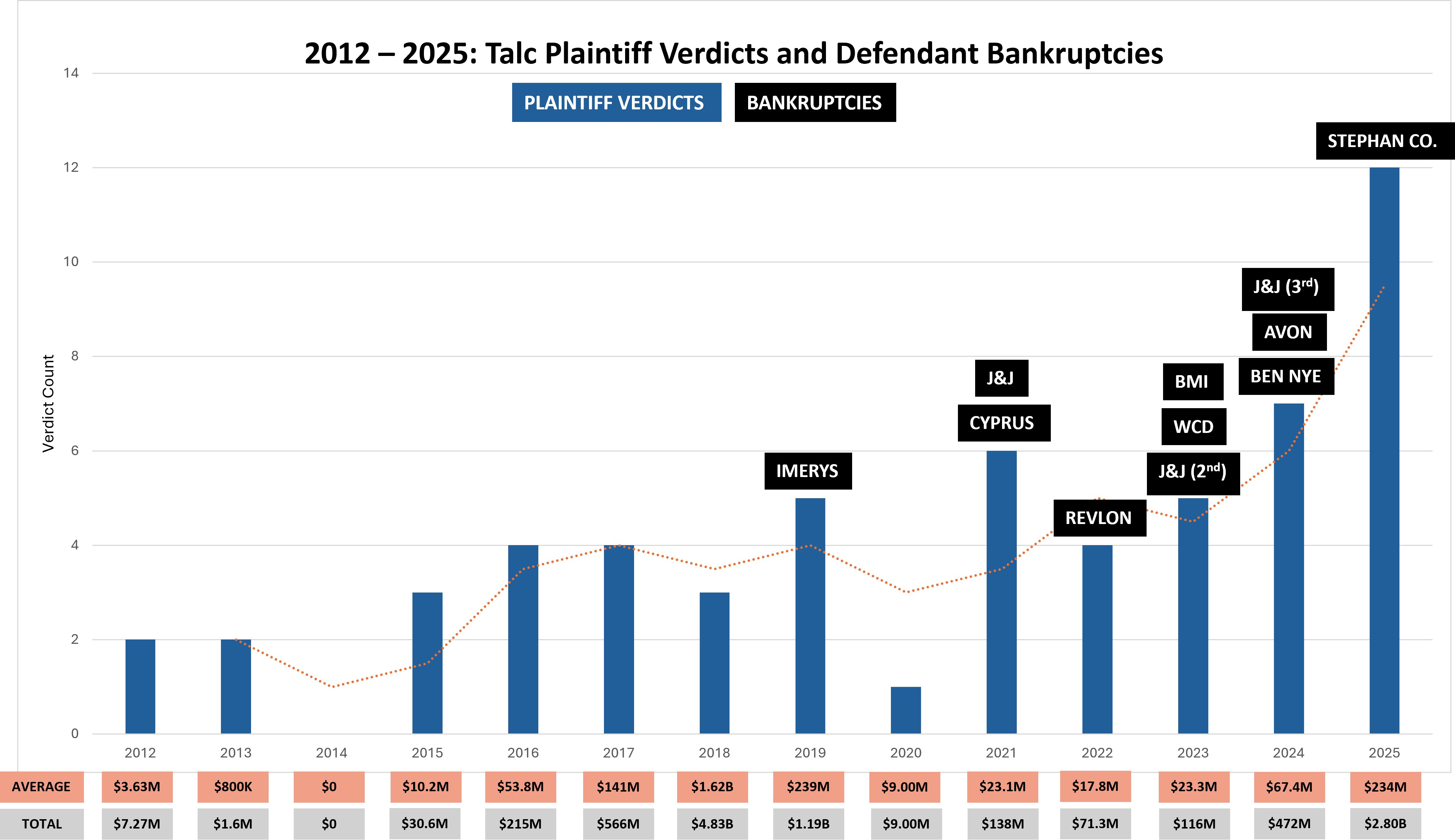
Before diving into 2026 verdict statistics, it is important to understand how talc litigation and verdicts have been evolving. The chart below details the number of talc-related plaintiff verdicts by year from 2012-2025 along with average and total amount awarded below each year. The number and value of these verdicts have escalated over time with 12 plaintiff verdicts in 2025 totaling $2.8B. This increase is exponential when compared to earlier years with only a couple of verdicts totaling well under $10M per year.
As we have seen with more traditional (non-talc-related) asbestos litigation, talc filing and verdict trends do relate to talc defendant bankruptcy filings. To illustrate this, the chart includes notations of talc defendant bankruptcy filings above each relevant year.
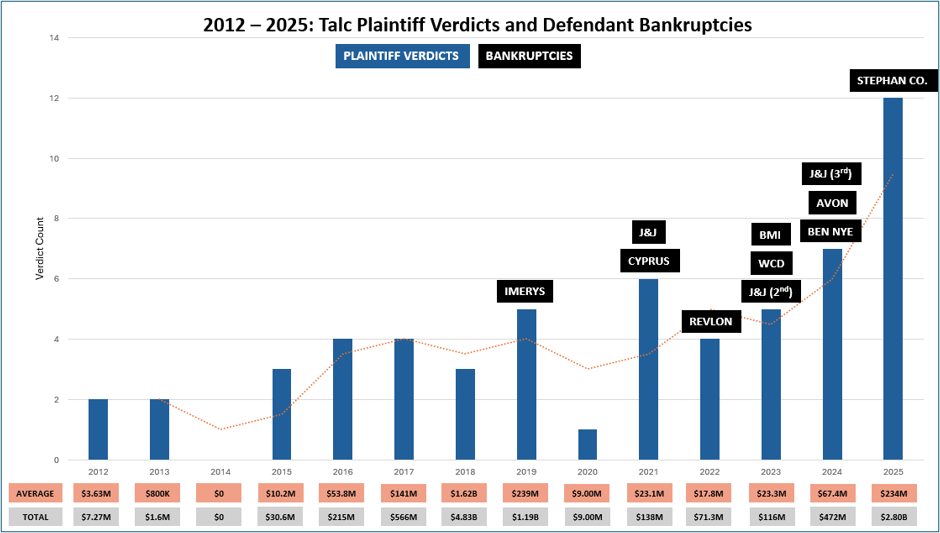
2012 - 2025 Talc Plaintiff Verdicts and Defendant Bankruptcies
Analysis of 2026 Verdicts at Mid-Year
So far in 2026, five talc-related mesothelioma verdicts have played a role in shaping the litigation landscape, and the scoreboard is nearly even between plaintiffs and defendants. A closer look at each of this year’s major talc verdicts helps illuminate the forces driving these mixed results.
A Los Angeles jury awarded $12.75 million to the family of a physician who died from mesothelioma after using talc-based cosmetic products manufactured by Port Jervis Laboratories, Inc. Jurors concluded that the products were a substantial factor in causing the disease and that the defendant failed to warn its consumers about potential hazards. The size of the award reinforces Los Angeles’s reputation as a plaintiff-friendly venue, even as judges later show willingness to reduce extreme awards on appeal.
A Cook County jury found in favor of Merck despite a professional hockey player’s claim that Dr. Scholl’s foot powder and Lotrimin caused his mesothelioma. The defense's success appeared to hinge on evidence of alternative causation and persuasive expert testimony. When jurors are convinced that other medical or environmental factors exist, they are less likely to extend liability to every product in the plaintiff’s environment.
An Oklahoma county jury returned a defense verdict for Johnson & Johnson in a case alleging that its talc-based products caused the plaintiff’s mesothelioma. The decision suggests that even in high-profile talc cases, jurors can decide that the evidence presented by the plaintiff does not clear the threshold necessary to establish a defendant’s liability.
A Minnesota jury awarded $10.2 million to a couple after finding that the husband’s use of talc-based powders led to his mesothelioma diagnosis. The jury assigned responsibility to various manufacturers, including Vi-Jon LLC, Sanofi, Merck, Johson & Johnson, and Perrigo Co. of Tennessee. This was one of the largest mesothelioma-related verdicts in Minnesota history.
A Los Angeles jury delivered a $32 million verdict against Johnson & Johnson after concluding that long-term baby powder use caused the plaintiff’s mesothelioma. As the largest plaintiff verdict of 2026 to date, it underscores that Los Angeles juries remain highly receptive to plaintiff causation theories, especially when the exposure narrative includes decades of loyal product usage.
In addition, there have been several notable talc-related mesothelioma case developments this year. In February, a Los Angeles judge entered a $24.6 million default judgment against the former owner of Gold Bond for failing to appear with counsel. In March, a Los Angeles judge overturned the $950 million punitive damages awarded against Johnson & Johnson after determining that the company did not act with malice. And in June, a Minnesota judge upheld a $65.5 million verdict against Johnson & Johnson while a Los Angeles judge declared a mistrial in a two-month trial against Johnson & Johnson after the jury failed to return a verdict.
Early Takeaways for 2026
Looking at the landscape as a whole, three crucial trends emerge.
First, juries are still saying “yes,” but they’re seemingly awarding less. Despite several defense wins, juries across venues continue to find that talc-containing products can cause cancer and are willing to impose significant damages when they believe defendants have withheld information from consumers. However, so far verdicts this year are smaller than the near‑billion‑dollar awards and massive punitive damages that closed out 2025. The average plaintiff award in 2025 exceeded $200 million, including punitive damages. Still, the $32 million Los Angeles verdict this year shows that plaintiff stories about trust, transparency, and corporate indifference continue to resonate deeply with jurors.
Second, defense wins are significant but often overshadowed. Verdicts for Merck in Cook County and Johnson & Johnson in Oklahoma demonstrate that defendants can win when they present rigorous testing, credible experts, and persuasive alternative exposure evidence. These outcomes show that talc litigation is not one-sided, even if certain venues seem to lean more favorably toward plaintiffs. Yet public perception is shaped heavily by publicity. When news organizations fail to highlight defense victories, the plaintiff‑dominant narrative fills the void and reinforces the impression that juries always side with claimants.
Third, venues matter, but judges matter just as much. Half of the plaintiff verdicts awarded this year in talc-related mesothelioma cases came from Los Angeles courtrooms, highlighting the crucial role that venue can play in verdict decisions. But courts have the power to act as stabilizers when judges scrutinize expert testimony, trim excessive awards, and overturn punitive damages that lack strong evidentiary support.
KCIC will continue to analyze talc-related filings and verdicts throughout 2026 and looks forward to providing additional updates.

Megan Burns combines her broad technical skills with an ability to lead client teams on a variety of projects. For example, she helps clients deploy KCIC’s Ligado Platform for claims management — helping manage their mass-tort data, especially in the asbestos personal injury arena.
Learn More About Megan